
Kind of work
Flight and space
1946–2011 · 2 artists · 3 works
Aircraft and spacecraft, kept for where they went and for what they were the first to do. This is not an art movement. It gathers the flying machines in the Atlas, which are shown as objects to walk around at their real size or as a scale model.
MoreLess
The Bell X-1 was the first aircraft flown faster than sound, on 14 October 1947. Columbia, the command module of Apollo 11, carried Neil Armstrong, Buzz Aldrin and Michael Collins to the Moon and back in July 1969. The space shuttle Discovery entered service in 1984 and flew 39 missions, more than any other orbiter. All three are kept by the Smithsonian's National Air and Space Museum.
Works
3 worksBell X-1 Glamorous Glennis
On 14 October 1947 this rocket plane, flown by Captain Charles Yeager, became the first aircraft to fly faster than sound. It was carried aloft under a bomber and released, and its orange paint was chosen to be seen. Aluminium; 9.4 m long with an 8.5 m wingspan. Shown at full size from the Smithsonian's scan.
Bell X-1 Glamorous Glennis sourceBell X-1 Glamorous Glennis sourceBell X-1 Glamorous Glennis source
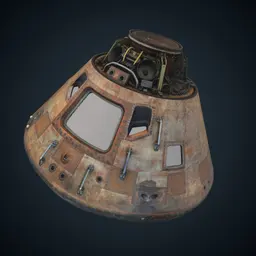
Apollo 11 Command Module Columbia
The only part of the Apollo 11 spacecraft to come home. In July 1969 this cabin carried Neil Armstrong, Buzz Aldrin and Michael Collins to the Moon and back, and its base still shows the burn of re-entry. Aluminium alloy, stainless steel and titanium structure with an ablative heat shield; 3.9 m across. Shown at full size from the Smithsonian's scan.
Apollo 11 Command Module Columbia sourceApollo 11 Command Module Columbia sourceApollo 11 Command Module Columbia source
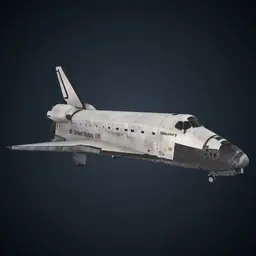
Space Shuttle Discovery
Discovery flew thirty-nine missions between 1984 and 2011, more than any other orbiter, and carried the Hubble Space Telescope into orbit. The real spacecraft is about 38 m long with a 24 m wingspan. It is shown here at one tenth of its size, from the Smithsonian's scan of the whole exterior.
Space Shuttle Discovery sourceSpace Shuttle Discovery sourceSpace Shuttle Discovery source