Movement
Hudson River School
1825–1875 · 5 artists · 6 works
A loose group of American landscape painters, about 1825 to the 1870s, who painted the wilderness of the Hudson valley and beyond as vast, detailed and awe-inspiring. The Hudson River School was a loose group of landscape painters based in New York City, active from about 1825 to the 1870s.
MoreLess
It was not a real school: the painters were friends who sketched together and showed their pictures side by side. The name comes from their views of the Hudson River valley and the Catskill Mountains north of the city. It began as an insult, once the style looked old-fashioned. Thomas Cole founded it, and Frederic Edwin Church, Albert Bierstadt and Sanford Robinson Gifford carried it on. They painted American wilderness as a new Eden and aimed at the sublime: a greatness too vast to measure, which stirs the strongest feelings, even fear, as storms and mountains do. They sketched outdoors, then built large, finely detailed canvases in the studio. In 1859 Church showed one such canvas alone to crowds who paid 25 cents each. As the country spread west the painters followed, to the Rocky Mountains and Yosemite, and some to South America. From the 1870s taste turned to more inward, poetic kinds of landscape: first Tonalism, then American Impressionism, with looser brushwork. The older pictures were admired again only from the 1960s.
Works
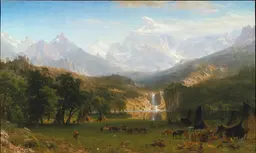
6 worksThe Rocky Mountains, Lander's Peak
A Shoshone camp fills a sunlit meadow below a waterfall and a wall of snow peaks in what is now Wyoming. Bierstadt built the scene in New York from sketches made with a government survey party in 1859. Oil on canvas, 186.7 × 306.7 cm.
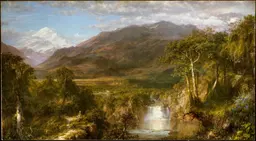
Heart of the Andes
A composite of the mountains, forests and rivers Church had sketched in Ecuador, painted three metres wide in his New York studio. In 1859 crowds paid to see it shown alone, and studied it through opera glasses. Oil on canvas, 168 × 302.9 cm.
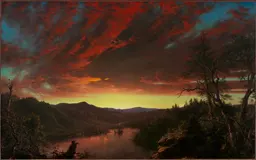
Twilight in the Wilderness
A blazing sunset over wild country near Mount Katahdin in Maine, painted in Church’s New York studio from sketches made nearly two years earlier. He showed the picture by itself in a gallery, and hundreds came to see it. Finished on the eve of the Civil War, it has often been read as a sign of the coming conflict. Oil on canvas, 101.6 × 162.6 cm.
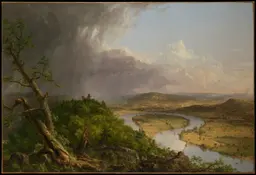
View from Mount Holyoke, Northampton, Massachusetts, after a Thunderstorm—The Oxbow
From a hilltop in Massachusetts, a storm moves off to the left over broken forest while sunlight returns to the farmland in the loop of the Connecticut River. Cole painted himself into the foreground, at work. Oil on canvas, 130.8 × 193 cm.
View from Mount Holyoke, Northampton, Massachusetts, after a Thunderstorm—The Oxbow source
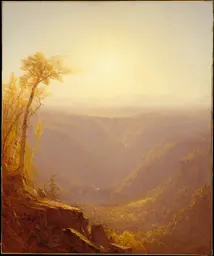
A Gorge in the Mountains (Kauterskill Clove)
The whole valley of Kaaterskill Clove in the Catskill Mountains dissolves in late sun. Gifford’s real subject is the lit haze itself; landscape painting, he said, is air painting. Oil on canvas, 121.9 × 101.3 cm.
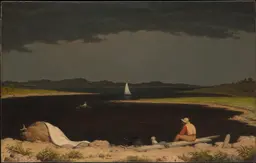
Approaching Thunder Storm
Black water, a darkening sky and one white sail: a storm is about to break over a small bay on the New England coast. A man in a red shirt sits with his dog and watches it come. Oil on canvas, 71.1 × 111.8 cm.
Getty Art & Architecture Thesaurus: Hudson River SchoolOlana State Historic Site: Church's ArtWadsworth Atheneum Museum of Art: teacher resource, Albert Bierstadt, In the MountainsTate, art terms: Sublime