Movement
Chinese literati painting
1279–1911 · 3 artists · 3 works
The Chinese tradition of scholar-amateur painting, which valued personal brushwork, poetry and the study of old masters above lifelike description. Literati painting (wenrenhua) was the art of scholar-amateurs: educated gentlemen, not professional painters, who painted for themselves and friends.
MoreLess
Its ideals were set out in the 11th century. A picture should go beyond the look of things and show the mind and learning of its maker. They prized brushwork learned from calligraphy, plain ink or quiet colour, and poems written on the picture. After the Mongol conquest of 1279 many scholars refused office and withdrew to the country. Huang Gongwang, Wu Zhen, Ni Zan and Wang Meng, the Four Masters of the Yuan, gave literati landscape its lasting forms, and the Ming-dynasty Wu school of Suzhou, led by Shen Zhou and Wen Zhengming, built on them. Painters used hanging scrolls, handscrolls unrolled bit by bit, and album leaves. To paint in the manner of an old master was to honour him, not merely to copy: the aim was to catch his spirit and make an old tune new. In the late Ming, Dong Qichang divided painting into a Northern school of skilled professionals and a Southern school of scholars, which he ranked higher. The Four Wangs followed him and, backed by the Qing emperors, formed the Orthodox school.
Works
3 worksPulling Oars under Clearing Autumn Skies 晴秋涉櫂圖
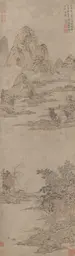
A tall, narrow view of a river in autumn: jagged peaks at the top, a single boat near the bottom, and a great deal of empty paper between. Lu Zhi wrote a poem on it about watching the cold river from his boat. Hanging scroll, ink and colour on paper, 105.8 × 31.1 cm.
Quiet Life in a Wooded Glen 林麓幽居圖
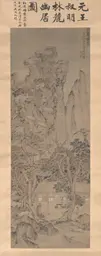
A scholar plays the zither in a cottage at the foot of towering, crowded mountains. Wang Meng, one of the Four Great Masters of the Yuan dynasty, painted it in 1361. Hanging scroll, ink and light colours on paper; the painting is 177.8 × 64.2 cm and is shown with its title panel and mount.
Landscape after Huang Gongwang
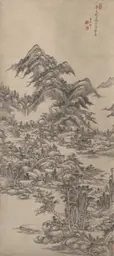
A mountain built up from dozens of small rounded forms rises over a valley of houses and a foreground of tall trees. Wang Yuanqi, a senior official at the court of the Kangxi emperor, inscribed it in 1701 as painted in the manner of the Yuan master Huang Gongwang. Hanging scroll, ink and colour on paper, 129.6 × 58.5 cm.
Getty Art & Architecture Thesaurus: Wen ren (Chinese literati painting)National Palace Museum, Taipei: A Closer Look at Chinese PaintingAsian Art Museum, San Francisco: Brushstrokes, Styles and Techniques of Chinese PaintingShanghai Museum: Chinese Painting Gallery