Movement
Mannerism
1520–1600 · 1 artist · 1 work
A cool, elegant and deliberately artificial style that followed the High Renaissance in Italy from about 1520 and spread to courts and cities across Europe. Mannerism comes from the Italian word maniera, which at first meant the style of one artist or of a whole school.
MoreLess
It names the art that followed the High Renaissance in Italy, from about 1520 to 1600. Its painters started from Leonardo, Raphael and above all Michelangelo. They did not aim at the same calm balance. They pushed their models further, towards elegance, artifice and a show of skill. The pictures are highly finished and knowingly stylish. Bodies are idealised and often stretched, colours are chosen for effect more than for truth to nature, and compositions are complicated and witty on purpose. In Florence, Jacopo Pontormo and Agnolo Bronzino painted this way, and Bronzino became official portrait painter to the Medici court. Parmigianino, from Parma, worked in Rome from 1524 until the city was sacked in 1527. It was an art for courts and cities that valued polish. It spread across Europe, helped by prints such as Parmigianino's etchings, and the elegant artifice of court painting in Elizabethan England is an echo of it.
Works
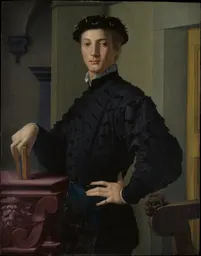
1 workPortrait of a Young Man
An unnamed young Florentine, book in hand, poses with studied ease between a table and a chair carved with grotesque faces. Bronzino later became court painter to the Medici dukes. Oil on wood, 95.6 × 74.9 cm.