Movement
Neo-Impressionism
1886–1906 · 2 artists · 1 work
A method developed by Georges Seurat for building a picture from small separate dots of pure colour that mix in the viewer's eye. Neo-Impressionism took the Impressionists' interest in light and colour and tried to give it rules.
MoreLess
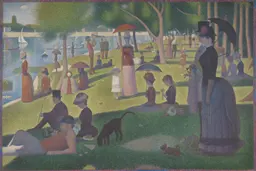
Georges Seurat studied the colour theories of scientists such as Chevreul. Instead of mixing paints on the palette, he set small dots and dashes of pure colour side by side. From a distance the eye blends them, and Seurat believed the colours looked more brilliant that way. The method is known as pointillism or divisionism. Seurat planned his pictures in the studio from many drawings and oil sketches. He began A Sunday on La Grande Jatte in 1884 and showed it in May 1886 at the eighth and last Impressionist exhibition, in a room shared with Paul Signac and Camille Pissarro. Pissarro painted this way for a few years and then went back to looser brushwork. The critic Félix Fénéon gave the style its name in a review that year. The movement is usually dated from 1886 to 1906. It grew out of Impressionism and reacted against its spontaneity, and it is often counted as one branch of Post-Impressionism.
Works
1 workA Sunday on La Grande Jatte — 1884
Parisians of every age and class spend a Sunday afternoon on an island in the Seine: strolling, fishing, lounging on the grass. Seurat built the whole scene, more than three metres wide, from small touches of colour set side by side. He worked on it for two years and later added the painted border. Oil on canvas, 207.5 × 308.1 cm.
Getty Art & Architecture Thesaurus: Neo-ImpressionistTate, art terms: Neo-ImpressionismNational Gallery, London, glossary: Neo-ImpressionismArt Institute of Chicago: Georges Seurat, A Sunday on La Grande Jatte, 1884