Movement
Realism
1840–1900 · 1 artist · 1 work
Painting of the world as it looks, without making it grander or prettier: a movement that began in France in the 19th century, and a word used more widely for any style that keeps to appearances. The Realist movement in painting began in France in the 19th century, above all with Gustave Courbet and Jean-François Millet.
MoreLess
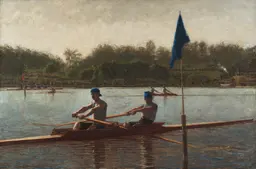
They turned away from the literary and exotic subjects of the Romantics and from the idealised forms of the classical tradition, and painted everyday life in a strong, natural style. The painters who followed them shared an approach, not a written programme. The word realism is also used more generally, for any style that resembles the world of appearances. The Cleveland Museum of Art describes Thomas Eakins of Philadelphia, who trained in the United States and in France, as renowned for the unsentimental realism of his paintings, which he built up from carefully prepared figure and perspective drawings. His Biglin Brothers Turning the Stake of 1873 records a real rowing race, held on the Schuylkill River in May 1872.
Works
1 workThe Biglin Brothers Turning the Stake
Barney and John Biglin swing their boat around the stake at the halfway point of a race on the Schuylkill River in Philadelphia in May 1872, with their rivals well behind. They won, and were the most celebrated oarsmen of their day. Eakins planned his pictures with careful perspective drawings. Oil on canvas, 101.3 × 151.4 cm.