Artist
Ancient Egypt
1500 BCE–1586 · Egyptian · 11 works in WOW
No makers' names survive for these royal Egyptian works: two obelisks later taken to Rome and the carved and painted tomb of Ramesses VI. No maker's name survives for these works, made for Egypt's kings.
MoreLess
The obelisk at St John Lateran, the oldest monument in Rome, was made for the pharaoh Thutmose III in the 15th century BC. The red granite Vatican Obelisk is said to have stood first at Heliopolis, raised for Amenemhet II; the emperor Caligula brought it to Rome. The tomb of Ramesses VI, KV9, in the Valley of the Kings shows how a royal tomb was made. Workmen cut corridors and chambers in a straight line deep into the rock. Ramesses V (about 1147 to 1143 BC) began it; his uncle Ramesses VI (about 1143 to 1136 BC) finished it and had the earlier gateways recarved with his names. The walls are in painted sunk relief: figures and signs cut into the surface, then coloured. They carry books of the afterlife, spells and maps of the underworld meant to let the king be reborn at dawn like the sun. Work stopped short: the burial chamber is smaller than planned, and some pillars were never fully cut free.
Where to see their work
3 places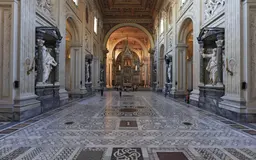
Works
11 worksVatican Obelisk
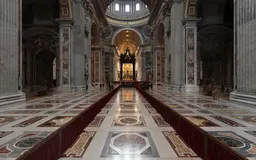
A red granite monolith 25.31 metres tall, standing at the centre of the Square on a base of 8.25 metres. It was brought from Egypt to Rome under the emperor Caligula and set up in his circus. Domenico Fontana moved it to its present place in 1586 for Pope Sixtus V.
vatican.va virtual tour of St Peter's Basilica, text "The Obelisk"St Peter's Basilica (Fabbrica di San Pietro): The Square
Lateran Obelisk
The obelisk in front of the Sistine portico, the basilica's other front. It was made for the pharaoh Thutmose III in the fifteenth century BC and later brought to Rome by the emperors. Pope Sixtus V had it set up in front of that portico, which he also rebuilt.
The king before Ra-Horakhty and Osiris
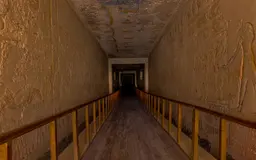
At the head of the first corridor the king stands before the gods on both walls. On the left, south wall he is before Ra-Horakhty and Osiris, in a scene first made for Ramesses V; on the right, north wall he offers incense to the same two gods. Beyond these scenes the Book of Gates begins on the left wall and the Book of Caverns on the right.
Describing Egypt: Valley of the Kings, Ramesses the Sixth Tomb (KV9)
Nut over the Books of the Day and the Night, upper ceilings
From the third corridor to the pillared hall the ceiling carries one long figure of the sky goddess Nut: her legs are over the third corridor and her head and arms over the middle of the pillared hall. Beneath her run the Book of the Day and the Book of the Night. The Book of the Night tells how the sun god Ra is swallowed by Nut in the evening and reborn in the morning.
Describing Egypt: Valley of the Kings, Ramesses the Sixth Tomb (KV9)
Ramesses VI before Osiris
In the middle of the rear wall of the pillared hall, above the descent, a double scene shows Ramesses VI burning incense and pouring a libation before Osiris. The four pillars beside the descent show the king before Khonsu, Amun-Ra, Meretseger, Ptah-Sokar-Osiris, Ra-Horakhty, Ptah and Thoth.
Describing Egypt: Valley of the Kings, Ramesses the Sixth Tomb (KV9)
Winged cobras and vultures of the descent
On the left, south wall of the descent the goddess Nekhbet is a winged cobra wearing the red and white crowns of Upper and Lower Egypt; on the wall opposite, Meretseger is a winged cobra wearing the red crown. On the underside of the overhang ahead, three vultures with outspread wings alternate with bands of text giving the names of Ramesses VI.
Describing Egypt: Valley of the Kings, Ramesses the Sixth Tomb (KV9)
The Amduat in the lower corridors
The walls of the two lower corridors carry the Amduat, the twelve hours of the night through which the sun god Ra travels the underworld. In the first corridor the first three hours are on the left wall and the sixth, the seventh and the start of the eighth on the right, where the corpse of Khepri lies surrounded by a five-headed snake called Many Faces. In the second corridor the fourth and fifth hours are on the left wall and the eighth to eleventh on the right.
Describing Egypt: Valley of the Kings, Ramesses the Sixth Tomb (KV9)
The resurrection of Osiris
The ceiling of the chamber before the burial chamber shows the resurrection of Osiris, with texts in cryptographic writing. On the half nearer the entrance Ramesses VI rides in the barks of the Day and the Night; on the half nearer the burial chamber Osiris lies as a mummy on a couch before Horus. Rows of divinities line the scenes on both halves.
Describing Egypt: Valley of the Kings, Ramesses the Sixth Tomb (KV9)
Ceiling of the burial chamber: Nut and the Books of the Day and the Night
The vault of the burial chamber is cut at a right angle to the axis of the tomb. The sky goddess Nut is drawn on it twice, dividing it in two. The eastern half is the Book of the Day, with red sun discs inside her yellow body on a very dark blue ground; the western half is the Book of the Night, with five-pointed stars inside her body on black.
Describing Egypt: Valley of the Kings, Ramesses the Sixth Tomb (KV9)
The Book of the Earth
The left, right and rear walls of the burial chamber are decorated with the Book of the Earth, as are the four pilasters of the rear wall, which are pillars left unfinished. The four pillars on the entrance side show Ramesses VI with Ma'at, Ptah-Sokar, Anubis, Meretseger, Osiris and Ptah.
Describing Egypt: Valley of the Kings, Ramesses the Sixth Tomb (KV9)
Sarcophagus of Ramesses VI
The burial pit was roughly widened to take a large granite sarcophagus box, now broken in two, with its foot half lying in the pit. The sarcophagus that stood inside it was shattered in antiquity; the box shown on the north side of the chamber was pieced together from hundreds of fragments in conservation work of the 2000s directed by Ted Brock, and its mummy-shaped lid is displayed in the middle niche of the rear wall. The head of the lid has been in London since the early nineteenth century, and the one in the tomb is a replica.
Describing Egypt: Valley of the Kings, Ramesses the Sixth Tomb (KV9)
See something wrong on this page? Report a mistakeOpening soon