Artist
Ancient Rome
1–1513 · Roman · 12 works in WOW
No makers' names survive for these Roman statues and early Christian mosaics; they stand for Rome's workshops from Augustus to the 5th-century popes. No sculptor's or mosaicist's name survives for these works.
MoreLess
They stand for the workshops of ancient Rome, from the emperor Augustus to the 5th-century popes. Sculptors portrayed rulers: a statue of Augustus from the early 1st century AD addresses his troops in a richly carved breastplate. Workshops also copied famous Greek statues, sometimes turning a bronze into marble. The Apoxyomenos, an athlete scraping oil and sand from his arm, was carved around 50 AD after a bronze by Lysippus of around 320 BC. Even the Augustus seems to follow a Greek model, the Doryphoros, or spear-bearer, by Polykleitos. In the 5th century popes had churches decorated in mosaic, pictures set in small pieces of glass and stone. Under Sixtus III, around 430, mosaicists filled St Mary Major's nave with Hebrew history and the arch before its apse with the childhood of Jesus, beginning Christian storytelling in pictures on a large scale. Leo the Great (440 to 461) had the arch of St Paul's decorated; restored several times since, it is tied to the Venetian mosaicists of St Mark's.
Where to see their work
5 placesProfane Museum
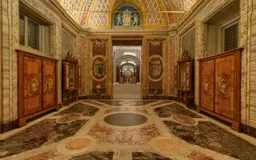
Vatican Museums · An eighteenth-century cabinet of antiquities
Pio Clementino Museum
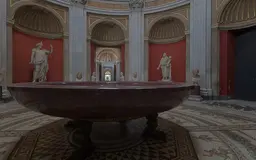
Vatican Museums · Halls of Greek and Roman sculpture
Braccio Nuovo (New Wing)
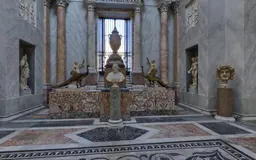
Vatican Museums · A marble gallery of Roman statues
St Mary Major
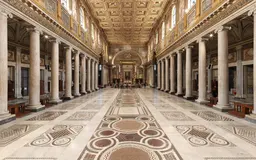
The great Marian basilica on the Esquiline Hill
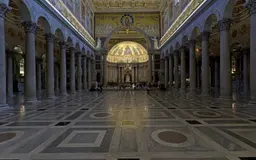
St Paul Outside the Walls
The basilica over the tomb of the Apostle Paul
Works
12 worksHead, portrait of Decimus Caelius Calvinus Balbinus
A bronze head with short curled hair and a short beard, set on a modern marble base. Of the four bronze heads in the hall it is the only one certainly ancient. Found on the Via Appia near Porta San Sebastiano, it was given to Clement XIV in 1771; Visconti identified it as Balbinus, the senator who became emperor at seventy in 238 AD and was killed after ninety-nine days.
Vatican Museums: Head, portrait of Decimus Caelius Calvinus Balbinus
Hercules Mastai
A gilded bronze statue of the young Hercules leaning on his club, the skin of the Nemean lion over his arm and the apples of the Hesperides in his left hand. It was found in 1864 near Campo de' Fiori, in the area of Pompey's Theatre, where it had been given a ritual burial after being struck by lightning. Pius IX acquired it shortly afterwards.
Sarcophagus of St Helena
A monumental sarcophagus of red porphyry, believed to have held the remains of Helena, mother of Constantine the Great, who died around 335 AD. Its sides are carved with Roman soldiers on horseback and barbarian prisoners, a military subject that has led scholars to think it was first made for a man of the imperial family. It was brought to the Vatican in 1777 and mounted on four lions carved by Francesco Antonio Franzoni.
Sarcophagus of Constantia
A monumental sarcophagus of red porphyry made for a daughter of Constantine the Great, most probably Constantia, who died in 354 AD and was buried in a mausoleum on the Via Nomentana. It is carved with garlands, grape vines, acanthus scrolls and cupids treading grapes. It came into the Vatican Museums in 1790 on a cart dragged by 40 oxen.
Meleager
The hero of Aetolia as the victorious huntsman, with his dog on one side and the head of the Calydonian boar on the other. It is a copy of the 2nd century AD after a lost Greek original of the mid 4th century BC attributed to Skopas. It was moved into the Vatican Museums in 1770.
Sleeping Ariadne
Ariadne asleep on the island of Naxos, abandoned by Theseus. Julius II acquired the statue in 1512 for the Courtyard of Statues, where it decorated a fountain, and it has lain in this niche since 1779. Because of its serpent bracelet it was long taken for Cleopatra, until Ennio Quirino Visconti recognised Ariadne at the end of the 1700s.
Apoxyomenos
An athlete scraping the oil and sand from his outstretched right arm with a strigil. The marble was made around 50 AD and copies a bronze that Lysippus made in his later years, around 320 BC. It was found in 1849 in Trastevere.
Augustus from Prima Porta
The emperor in the act of addressing his troops, in a highly decorated cuirass with his cloak wrapped round his hips. The statue was found in the ruins of the Villa of Livia, his wife, at Prima Porta on the Via Flaminia. The reliefs on the cuirass show a Parthian king returning to a Roman officer the standards lost by Crassus in 53 BC.
The Nile
A colossal statue of the river as an old man stretched out on his side, a cornucopia in his left arm and ears of wheat in his right hand, leaning on a sphinx. Sixteen children climb over him, for the sixteen cubits by which the Nile rises in its yearly flood. It was found in 1513 in the Campo Marzio, where it probably decorated the sanctuary of Isis and Serapis.
Peacocks
Two gilded bronze peacocks, recorded in the early Middle Ages near Hadrian's Mausoleum, today Castel Sant'Angelo. For a long time they stood with the great bronze pinecone at the fountain in front of old St Peter's. In 1608 they were moved to the Courtyard of the Pinecone, and later they were brought in here to preserve them.
Mosaic of the triumphal arch
Pope Leo the Great had the arch before the apse decorated in mosaic: a blessing Christ between two angels and the twenty-four Elders of the Apocalypse, with Peter and Paul below. The basilica's page ties the mosaic to the Venetian mosaicists of St Mark's and says it was touched up and restored several times, so how much of it is fifth-century work is unclear. It was set in its present place after the fire of 1823.
Papal Basilica of Saint Paul Outside-the-Walls (vatican.va): From the 5th to the 8th Century
See something wrong on this page? Report a mistakeOpening soon