Artist · High Renaissance
Michelangelo
1475–1564 · Italian · 7 works in WOW
Italian sculptor, painter, architect and poet of the Renaissance, who painted the ceiling and the Last Judgement of the Sistine Chapel. Michelangelo Buonarroti was born in Caprese, a small town that his father governed for Florence.
MoreLess
At 13, in Florence, he was apprenticed to the painter Domenico Ghirlandaio. He soon turned to sculpture under the protection of Lorenzo de' Medici. In Rome, from 1496, he carved the Pietà for St Peter's. In 1508 Pope Julius II hired him to repaint the ceiling of the Sistine Chapel. The first plan was for twelve apostles. Michelangelo called it a poor thing and was allowed to plan the work himself. By October 1512 he had covered the vault with nine scenes from the Book of Genesis, prophets, sibyls and the ancestors of Christ, all in fresco, which is paint laid on fresh wet plaster. Painters across Italy then built a new style, later called Mannerism, on its twisting figures and bright colour. He returned to the chapel in 1536 to paint the Last Judgement on the altar wall, and finished it in 1541. Frescoes by Perugino were destroyed to make room for it, and it was influenced by Luca Signorelli's frescoes at Orvieto. Straight after the Last Judgement he painted his last two frescoes, the Conversion of Saint Paul and the Crucifixion of Saint Peter, on the side walls of the nearby Pauline Chapel. He also designed the dome of St Peter's and built it up to the drum; Giacomo della Porta finished it after his death. Michelangelo worked in Rome for his last thirty years and died there in 1564, aged 88.
Where to see their work
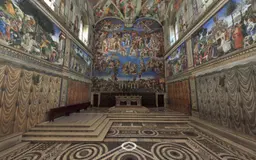
3 placesThe Sistine Chapel
Fourteen real viewpoints inside the hall, seven on the floor and seven up at the windows, on a model measured from the photographs.
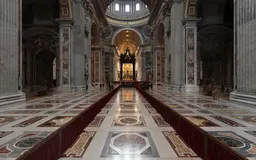
St Peter's Basilica
The basilica and its Square in eleven photographs
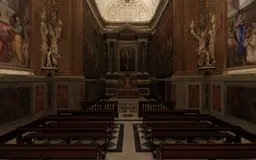
Pauline Chapel
Michelangelo's last two frescoes
Works
7 worksThe Sistine Chapel Ceiling
Nine central scenes from Genesis sit within a painted architectural framework. Around them are prophets, sibyls, ancestors of Christ, and corner scenes of salvation.
The Creation of Adam
God reaches toward Adam in one of the ceiling’s central Genesis scenes. This photograph also records surrounding painted architecture; the study view preserves that source context.
The Last Judgment
Christ dominates the altar-wall composition. Around him, saints await judgment while the lower groups rise or descend. Some figures received painted coverings after Michelangelo’s death.
Pietà
Mary holds the dead Christ across her lap, carved from a single block of Carrara marble. The French cardinal Jean de Bilhères Lagraulas commissioned it in 1498 for his tomb in a chapel beside old St Peter's, when Michelangelo was twenty-three. It is the only work he signed: his name runs along the band across the Virgin's breast. It stands behind glass in the first chapel of the right aisle.
St Peter's Basilica (Fabbrica di San Pietro): The Pietà of Saint Peter'svatican.va virtual tour of St Peter's Basilica, text "Michelangelo's Pietà"
Dome of St Peter's
Michelangelo conceived the dome and built it as far as the drum; after his death Giacomo della Porta, working with Domenico Fontana, raised it between 1588 and 1590 on a more pointed curve than the first design. Its sixteen compartments were covered with mosaic between 1598 and 1613. Around the base, in blue letters on gold, run Christ's words to Peter that begin "Tu es Petrus".
St Peter's Basilica (Fabbrica di San Pietro): The Domevatican.va virtual tour of St Peter's Basilica, text "The Cupola"
Conversion of Saint Paul
The fresco on the left wall as you face the altar. Christ reaches down in a shaft of light and Saul lies thrown to the ground, while his companions scatter and his horse bolts. Michelangelo painted it between the end of 1542 and July 1545, straight after the Last Judgement in the Sistine Chapel.
Office for the Liturgical Celebrations of the Supreme Pontiff: The Pauline Chapel
Crucifixion of Saint Peter
The fresco on the right wall. Peter, fixed head down to the cross, twists round to stare out at the viewer as the cross is lifted. Michelangelo began it as soon as the Conversion of Saint Paul was done and finished it in March 1550; the two are his last frescoes.
Office for the Liturgical Celebrations of the Supreme Pontiff: The Pauline Chapel
See something wrong on this page? Report a mistakeOpening soon
Vatican Museums: Sistine Chapel, CeilingGetty Union List of Artist Names: Michelangelo BuonarrotiNational Gallery, London: MichelangeloVatican Museums: Sistine ChapelOffice for the Liturgical Celebrations of the Supreme Pontiff: The Pauline ChapelSt Peter's Basilica (Fabbrica di San Pietro): The Dome