Artist · Dutch Golden Age
Rembrandt van Rijn
1606–1669 · Dutch · 2 works in WOW
Dutch painter and printmaker who used strong light and deep shadow to show people thinking and feeling, from Bible scenes to dozens of self-portraits. Rembrandt van Rijn was born in Leiden in 1606, the son of a miller.
MoreLess
He left the university after a few months to train as a painter, in Leiden and then briefly with Pieter Lastman in Amsterdam. Around 1631 he moved to Amsterdam and became the most famous artist in the city. He lit his scenes like a stage: a face or a hand catches the light while the rest sinks into shadow. In The Night Watch, his largest painting, he turned a group portrait into a moment of action. He made many etchings, a kind of print, and about 80 self-portraits by him survive. His early pictures are smooth and exact. The late ones are built from broad strokes, some laid on with a palette knife. His wife Saskia died in 1642. He spent heavily on art and curiosities and went bankrupt in 1656. He kept painting until he died in 1669. His pupils included Carel Fabritius, who later worked in Vermeer's Delft. In 1890 Vincent van Gogh painted his own version of Rembrandt's print The Raising of Lazarus.
Where to see their work
2 places
Works
2 worksAristotle with a Bust of Homer
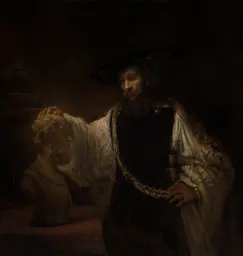
The Greek philosopher Aristotle rests a hand on a bust of the poet Homer. From his gold chain hangs a medal of his pupil Alexander the Great. Rembrandt painted the picture in Amsterdam for a Sicilian collector, Don Antonio Ruffo. Oil on canvas, 143.5 × 136.5 cm.
Self-Portrait
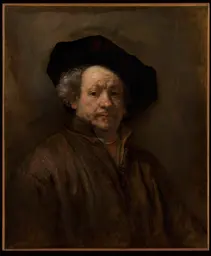
Rembrandt was fifty-four when he painted this likeness, one of about forty painted self-portraits made across his life. He records the furrowed brow and the heavy cheeks without softening them. Oil on canvas, 80.3 × 67.3 cm.
See something wrong on this page? Report a mistakeOpening soon
The Metropolitan Museum of Art: Aristotle with a Bust of HomerGetty Union List of Artist Names: Rembrandt van RijnNational Gallery, London: RembrandtRijksmuseum: Rembrandt van RijnVan Gogh Museum: The Raising of Lazarus (after Rembrandt)