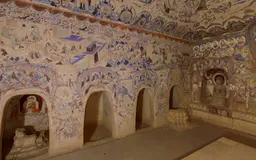
Dunhuang, Gansu, China
Mogao Cave 285
Painted Buddhist cave temple, Western Wei dynasty
Cave 285 is a Buddhist cave temple at the Mogao Grottoes, Dunhuang, cut in the Western Wei dynasty. Votive texts on its north wall carry the dates of the fourth and fifth years of the Datong era, 538 and 539, and the Dunhuang Academy describes it as the earliest cave at Dunhuang with a firm date.
MoreLess
The main chamber is square under a ceiling shaped like a truncated pyramid. A large niche in the west wall holds a seated Buddha, with a meditating monk in the small niche on either side; the north and south walls each open into four small meditation cells; the square altar in the middle of the floor was added in the Yuan dynasty. Every surface is painted: Buddhas preaching above rows of donors, the story of the five hundred robbers, and on the ceiling the gods of Chinese myth beside the protectors of Buddhist law. The six views are the Dunhuang Academy's own panoramas from its Digital Dunhuang site, from the walkway outside the door, through the corridor, to the foot of the niche.
Where you can stand
6 views- 1Outside the cave door, on the cliff walkway
- 2In the entrance corridor, between two Tang paintings of Avalokitesvara, the main chamber ahead
- 3Main chamber, just inside the door, facing the west niche across the central platform
- 4North side of the main chamber, under the seven preaching scenes
- 5South-west corner of the main chamber, under the story of the five hundred robbers
- 6In front of the west niche, beside the seated Buddha
What to look for
7 works- China, Western Wei dynasty535–557
- Seated Buddha and meditating monks of the west nichesWestern Wei dynasty; votive texts on the north wall are dated 538 and 539
- Guardian deities of the west wallWestern Wei dynasty; votive texts on the north wall are dated 538 and 539
- Ceiling: canopy and the four slopesWestern Wei dynasty; votive texts on the north wall are dated 538 and 539
- The story of the five hundred robbersWestern Wei dynasty; votive texts on the north wall are dated 538 and 539
- Seven preaching scenes with donorsWestern Wei dynasty; votive texts on the north wall are dated 538 and 539
- Amitayus preaching, beside the doorWestern Wei dynasty; votive texts on the north wall are dated 538 and 539
- China, Tang dynasty618–907
- Two forms of Avalokitesvara in the corridorMiddle Tang period
See something wrong on this page? Report a mistake · Have better photographs of this place? Tell usOpening soon