Artist
China, Western Wei dynasty
535–557 · Chinese · 6 works in WOW
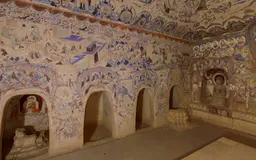
No names survive for the makers of Mogao Cave 285, made under the Western Wei dynasty and dated by written prayers of 538 and 539. No sculptor's or painter's name is recorded for Cave 285 at the Mogao Grottoes, near Dunhuang in northwestern China.
MoreLess
It was made under the Western Wei, a dynasty ruling from Chang'an from 535 until the Northern Zhou replaced it in 557. Written prayers on its north wall are dated 538 and 539, making it the earliest cave at Dunhuang with a firm date. The Mogao caves were cut into a cliff of soft conglomerate, a rock of pebbles bound together. The walls were plastered with clay, sand and plant fibre; painters drew in red and black ink on a ground layer, then filled in bright mineral pigments. The Buddha and two meditating monks in the west niches are modelled figures. The paintings join two worlds. Figures of Chinese myth, such as Fuxi and Nüwa with their snake tails, share the ceiling with Buddhist guardians and thunder gods. The south wall tells of five hundred robbers who are blinded, healed and become monks; rows of donors stand below the preaching Buddhas of the north wall.
Where to see their work
1 placeWorks
6 worksSeated Buddha and meditating monks of the west niches
The large arched niche in the middle of the west wall holds a Buddha seated with his legs pendent, preaching. The small niche on either side holds a statue of a monk in meditation wearing a cowl.
Digital Dunhuang: Mogao Grottoes Cave 285 (Dunhuang Academy)
Guardian deities of the west wall
Around the three niches the wall is painted with protectors of Buddhist law. High on the south side the sun god rides a chariot drawn by four horses, and on the north side the moon god sits in his chariot above a car drawn by three lions. Between the central niche and the north niche Mahesvara, with three heads and six arms, rides a white ox, above Kumara on a peacock and Vinayaka with his elephant's trunk; heavenly kings in armour stand at the foot of the wall.
Digital Dunhuang: Mogao Grottoes Cave 285 (Dunhuang Academy)
Ceiling: canopy and the four slopes
The square at the top of the ceiling is painted as a canopy with a lotus at its centre, hung round with draperies and bells. The four slopes carry figures of Chinese myth together with Buddhist guardians: Fuxi and Nüwa with their snake tails on the east slope, the Mani pearl, the god of thunder beating his drums, apsaras and many-headed beasts. Along the foot of the slopes monks sit in meditation in huts among mountains, with wild animals and hunters between them.
Digital Dunhuang: Mogao Grottoes Cave 285 (Dunhuang Academy)
The story of the five hundred robbers
The middle band of the south wall tells one story from end to end: the robbers fight the army, are captured, are judged by the king, have their eyes put out and are driven into the mountains, where their sight returns, the Buddha preaches to them and they become monks. The band ends with Sakyamuni and Prabhutaratna seated side by side. Above it fly apsaras playing music, and below it are the four meditation cells.
Digital Dunhuang: Mogao Grottoes Cave 285 (Dunhuang Academy)
Seven preaching scenes with donors
The upper part of the north wall is filled by seven scenes of Buddhas preaching, each with a votive text and rows of men and women donors beneath it. The inscriptions name Kasyapa Buddha, Kanakamuni and Amitayus among the Buddhas, and it is their dates, the fourth and fifth years of the Datong era, that date the cave. Below are four meditation cells; remains of small pagodas built in the Yuan dynasty stand at some of the openings.
Digital Dunhuang: Mogao Grottoes Cave 285 (Dunhuang Academy)
Amitayus preaching, beside the door
Three Buddhas preach above the door in the east wall. To the north and to the south of the door is a large scene of Amitayus preaching, with rows of donors below. In the southern scene the written names of his companions can still be read: the bodhisattvas Aksayamati, Avalokitesvara, Manjusri and Mahasthamaprapta, and the disciples Ananda, Sariputra, Mahakasyapa and Maudgalyayana.
Digital Dunhuang: Mogao Grottoes Cave 285 (Dunhuang Academy)
See something wrong on this page? Report a mistakeOpening soon