Movement
Post-Impressionism
1886–1905 · 3 artists · 5 works
A later name for painters, chiefly Cézanne, Gauguin, Seurat and Van Gogh, who started from Impressionism around 1886 and each took it somewhere different. Post-Impressionism is not one style. It is a name for what happened to Impressionism from about 1886, the year of the last Impressionist exhibition.
MoreLess
The painters knew Impressionism well and wanted more from a picture than a record of what the eye sees: firmer structure, stronger feeling or a meaning beyond the scene. Paul Cézanne built landscapes and still lifes from blocks of colour and looked for the structure under a view. Vincent van Gogh, who came to Paris in 1886 and moved to Provence in 1888, used bold colour and thick, broken brushwork. Georges Seurat set down dots of pure colour by rule; his method has its own name, Neo-Impressionism. Japanese ukiyo-e prints, with their flat colour and bold outlines, gave Van Gogh a model for a modern kind of painting. The name came later. The British painter and critic Roger Fry coined it for Manet and the Post-Impressionists, the exhibition he organised in London in 1910.
Works
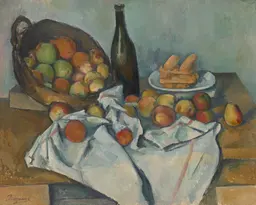
5 worksThe Basket of Apples
A table that will not hold still: the two halves of its front edge do not line up, the bottle leans, and the apples seem about to roll out of the picture. Cezanne painted each thing as he saw it from where he stood, and let the views disagree. Oil on canvas, 65 × 80 cm.
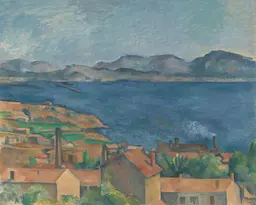
The Bay of Marseille, Seen from L'Estaque
From the village of L’Estaque, Cezanne looks across the bay to the hills beyond Marseille. He stacks the view in four bands (roofs, water, mountains, sky) and builds each from block-like strokes of strong colour. Oil on canvas, 80.2 × 100.6 cm.
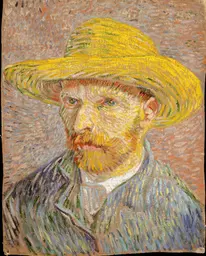
Self-Portrait with a Straw Hat
Painted in Paris, this self-portrait uses short strokes and contrasting colors. Van Gogh painted it on the reverse of an earlier study.
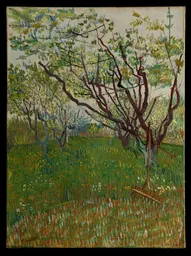
The Flowering Orchard
Van Gogh painted this orchard during his first spring in Arles. The branching forms reflect his interest in Japanese prints; the tools hint at the people tending the trees.
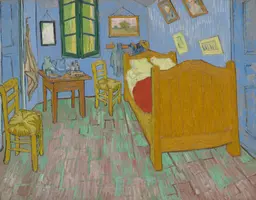
The Bedroom
Van Gogh’s own bedroom in the Yellow House at Arles: a wooden bed, two chairs, a small table, pictures on the walls. He painted the room three times. This is the second version, made in September 1889, nearly a year after the first. Oil on canvas, 73.6 × 92.3 cm.
Tate, art terms: Post-ImpressionismNational Gallery, London, glossary: Post-ImpressionismGetty Art & Architecture Thesaurus: Post-ImpressionistArt Institute of Chicago: Paul Cezanne, The Bay of Marseille, Seen from L'Estaque