Artist · Post-Impressionism
Paul Cézanne
1839–1906 · French · 3 works in WOW
French painter who built pictures from small, ordered strokes of colour, giving Impressionism a new solidity that shaped Picasso and much of modern art. Paul Cézanne was born in Aix-en-Provence, the son of a wealthy banker and a boyhood friend of the writer Émile Zola.
MoreLess
He studied law to please his family while taking drawing lessons, then left for Paris in 1862 to paint. In his early pictures the paint is laid on thickly with a palette knife. In 1872 he moved to Auvers-sur-Oise and painted outdoors beside Camille Pissarro, who guided him. He showed with Monet, Renoir and Pissarro in the first Impressionist exhibition of 1874. But he wanted, he said, to 'make of Impressionism something solid and durable like the art of museums'. He worked slowly, using small, blocky strokes of warm and cool colour to build up form. He kept returning to a few subjects: apples on a tilted table, the bay at L'Estaque, the landscape of Provence, bathers. His first exhibition of his own, at Ambroise Vollard's gallery in Paris in 1895, brought him wide notice. Younger painters took him as their guide, and Picasso is said to have called him 'the father of us all'. He died in Aix in 1906.
Where to see their work
2 placesWorks
3 worksThe Basket of Apples
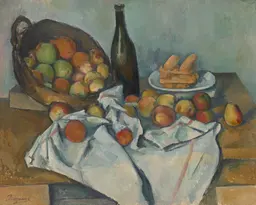
A table that will not hold still: the two halves of its front edge do not line up, the bottle leans, and the apples seem about to roll out of the picture. Cezanne painted each thing as he saw it from where he stood, and let the views disagree. Oil on canvas, 65 × 80 cm.
The Bay of Marseille, Seen from L'Estaque
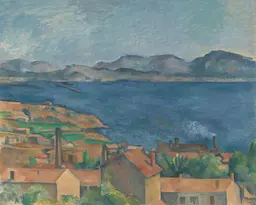
From the village of L’Estaque, Cezanne looks across the bay to the hills beyond Marseille. He stacks the view in four bands (roofs, water, mountains, sky) and builds each from block-like strokes of strong colour. Oil on canvas, 80.2 × 100.6 cm.
Auvers, Panoramic View
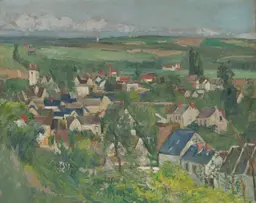
Cezanne looks down over the roofs of Auvers and out to the open country, during his first long stay in the village, where the painter Camille Pissarro was his mentor. The blocky patches of colour and the loosely brushed foreground were radical choices at the time. Oil on canvas, 65.2 × 81.3 cm.
See something wrong on this page? Report a mistakeOpening soon
Art Institute of Chicago: Paul CezanneGetty Union List of Artist Names: Paul CézanneNational Gallery, London: Paul CezanneMusée de l'Orangerie: Paul Cezanne