Artist · Impressionism
Claude Monet
1840–1926 · French · 6 works in WOW
French painter who led the Impressionists in painting light outdoors, then spent decades painting one subject many times as the light changed. Claude Monet was born in Paris and grew up in Le Havre, in Normandy, where the painter Eugène Boudin showed him how to paint from nature.
MoreLess
He came to Paris in 1859 and, three years later, met Pierre-Auguste Renoir in the studio of the painter Charles Gleyre. In 1869 the two painted side by side on the Seine, with quick, broken brushstrokes. In 1874 Monet, Camille Pissarro and Edgar Degas helped set up a group show apart from the official Salon. One of his pictures there, Impression, Sunrise, gave the group its name, which was first meant as an insult. He worked outdoors, in front of his subject, and often finished a canvas in the studio. In 1883 he moved to Giverny, north-west of Paris. From 1890 he painted in series, showing one subject, such as stacks of wheat, poplars or Rouen Cathedral, at different hours and seasons. He made a water garden there and painted its water lilies for nearly thirty years, even as his sight failed. He died at Giverny in 1926, aged 86.
Where to see their work
3 places
Works
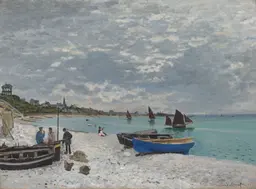
6 worksThe Beach at Sainte-Adresse
Monet spent the summer of 1867 with his aunt at Sainte-Adresse, beside the port of Le Havre where he grew up. Fishermen and their dark-sailed boats fill the shingle, and two seated holidaymakers, small at the water’s edge, mark the village’s new life as a resort. Oil on canvas, 75.8 × 102.5 cm.
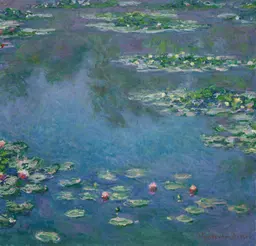
Water Lilies
Only the surface of the pond: no bank, no bridge, no sky except its reflection. Monet painted his water garden at Giverny about 250 times, and this nearly square canvas comes from the middle of that long series. Oil on canvas, 89.9 × 94.1 cm.
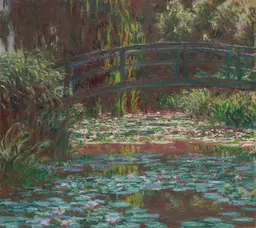
Water Lily Pond
The Japanese-style footbridge that Monet built over his pond at Giverny arches across the top of the canvas, with water lilies and reflections filling the water below. It is one of eighteen versions of the view that he painted in 1899 and 1900. Oil on canvas, 89.8 × 101 cm.
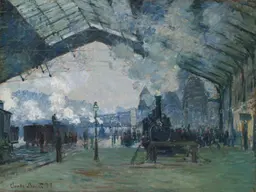
Arrival of the Normandy Train, Gare Saint-Lazare
Under the glass-and-iron shed of the Saint-Lazare station in Paris, a locomotive arrives in a cloud of steam. Monet painted twelve views of the station, and had eight of them ready for the Impressionist exhibition of 1877. Oil on canvas, 60.3 × 80.2 cm.
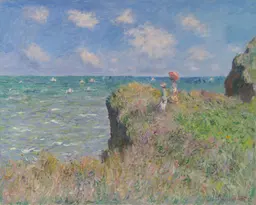
Cliff Walk at Pourville
Two young women stand on a cliff above the sea at Pourville, a fishing village on the Normandy coast where Monet painted in 1882. The same short, curved strokes make the grass, the dresses and the waves, so that everything seems to move in one wind. Oil on canvas, 66.5 × 82.3 cm.

Stacks of Wheat (End of Summer)
Two stacks of wheat stand in a field beside Monet’s house at Giverny, their pointed tops rising above the line of the hills. He painted the stacks through 1890 and 1891 in changing light and seasons, and showed fifteen of the canvases together in Paris. Oil on canvas, 60 × 100.5 cm.
See something wrong on this page? Report a mistakeOpening soon
Art Institute of Chicago: Claude MonetGetty Union List of Artist Names: Claude MonetNational Gallery, London: Claude MonetMusée de l'Orangerie: The Water Lilies by Claude Monet