Movement
Impressionism
1860–1886 · 8 artists · 16 works
A French way of painting modern life and landscape quickly, often outdoors, with broken touches of bright colour that catch passing effects of light. The Impressionists wanted to paint what the eye sees at one moment: sunlight on water, steam in a railway station, a crowd on a boulevard.
MoreLess
From the early 1860s Claude Monet and other young painters in Paris worked fast, in front of the subject and often outdoors, using the new artists' materials of their day. Their brushstrokes stay visible as separate dabs of pure, bright colour. Rejected by the art establishment, the group held its own exhibition in Paris in 1874. A critic's mockery of Monet's Impression, Sunrise gave them their name, and seven more exhibitions followed, the last in 1886. Monet, Renoir, Degas, Pissarro and Morisot were at the centre. Cézanne showed with them in 1874, Caillebotte joined in 1876, and Mary Cassatt, the only American, in 1879. Japanese ukiyo-e prints, then on sale in Paris, showed Degas and Cassatt how to crop a view and flatten space. From 1886 Seurat's Neo-Impressionism and the painters later called Post-Impressionists took the new freedom in other directions.
Works
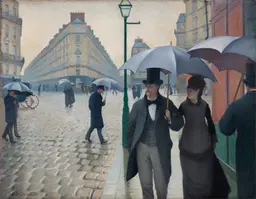
16 worksParis Street; Rainy Day
Caillebotte’s largest painting shows a broad new intersection in Paris, a short walk from his home. No raindrops are painted: the weather is told by the umbrellas and by the sheen on the cobblestones. Oil on canvas, 212.2 × 276.2 cm.
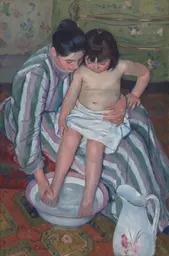
The Child's Bath
A woman steadies a child on her lap and washes one small foot in a basin. Cassatt, the only American invited to exhibit with the French Impressionists, sets the scene steeply from above and fills it with pattern, lessons she drew from Japanese woodblock prints. Oil on canvas, 101.3 × 67.3 cm.
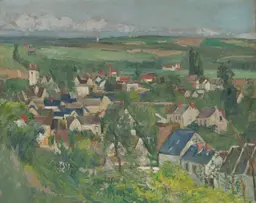
Auvers, Panoramic View
Cezanne looks down over the roofs of Auvers and out to the open country, during his first long stay in the village, where the painter Camille Pissarro was his mentor. The blocky patches of colour and the loosely brushed foreground were radical choices at the time. Oil on canvas, 65.2 × 81.3 cm.
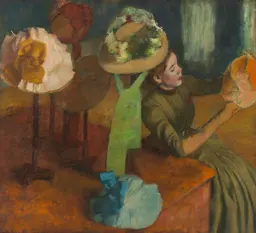
The Millinery Shop
The largest of Degas’s paintings of milliners looks down on a young woman studying a hat among the shop’s displays. Degas placed a second hat, trimmed in green, so that it seems to sit on her own head. Oil on canvas, 100 × 110.7 cm.
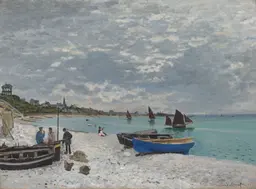
The Beach at Sainte-Adresse
Monet spent the summer of 1867 with his aunt at Sainte-Adresse, beside the port of Le Havre where he grew up. Fishermen and their dark-sailed boats fill the shingle, and two seated holidaymakers, small at the water’s edge, mark the village’s new life as a resort. Oil on canvas, 75.8 × 102.5 cm.
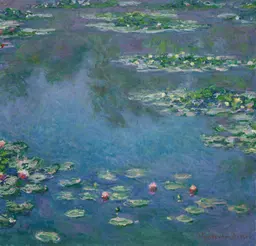
Water Lilies
Only the surface of the pond: no bank, no bridge, no sky except its reflection. Monet painted his water garden at Giverny about 250 times, and this nearly square canvas comes from the middle of that long series. Oil on canvas, 89.9 × 94.1 cm.
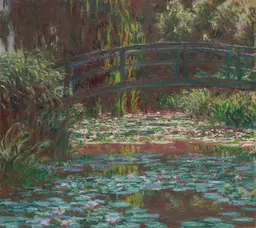
Water Lily Pond
The Japanese-style footbridge that Monet built over his pond at Giverny arches across the top of the canvas, with water lilies and reflections filling the water below. It is one of eighteen versions of the view that he painted in 1899 and 1900. Oil on canvas, 89.8 × 101 cm.
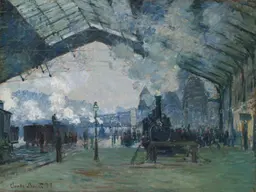
Arrival of the Normandy Train, Gare Saint-Lazare
Under the glass-and-iron shed of the Saint-Lazare station in Paris, a locomotive arrives in a cloud of steam. Monet painted twelve views of the station, and had eight of them ready for the Impressionist exhibition of 1877. Oil on canvas, 60.3 × 80.2 cm.
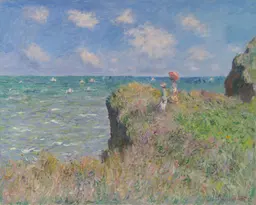
Cliff Walk at Pourville
Two young women stand on a cliff above the sea at Pourville, a fishing village on the Normandy coast where Monet painted in 1882. The same short, curved strokes make the grass, the dresses and the waves, so that everything seems to move in one wind. Oil on canvas, 66.5 × 82.3 cm.

Stacks of Wheat (End of Summer)
Two stacks of wheat stand in a field beside Monet’s house at Giverny, their pointed tops rising above the line of the hills. He painted the stacks through 1890 and 1891 in changing light and seasons, and showed fifteen of the canvases together in Paris. Oil on canvas, 60 × 100.5 cm.
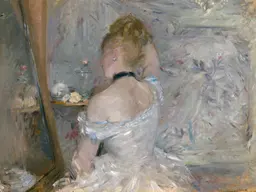
Woman at Her Toilette
A woman seen from behind lifts a hand to her hair at her dressing table, a black ribbon still at her neck. Morisot paints the room, the dress and the mirror in the same quick, silvery strokes, and signs her name along the mirror’s lower edge. Oil on canvas, 60.3 × 80.4 cm.
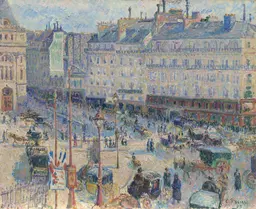
The Place du Havre, Paris
Early in 1893 Pissarro took a room at the Hôtel Garnier in Paris and painted the traffic below his window. The building at the far left edge is the Saint-Lazare railway station. Oil on canvas, 60.1 × 73.5 cm.
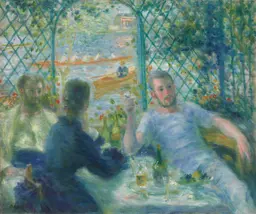
Lunch at the Restaurant Fournaise (The Rowers' Lunch)
Three friends linger at a table under a trellis at the Restaurant Fournaise, a meeting place for rowers on the Seine at Chatou, just outside Paris. Renoir dissolves the end of the lunch into dappled blues and greens, with a skiff sliding past on the river behind them. Oil on canvas, 55 × 65.9 cm.
Lunch at the Restaurant Fournaise (The Rowers' Lunch) source
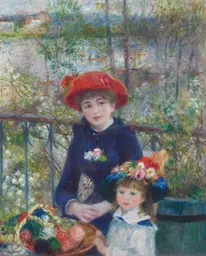
Two Sisters (On the Terrace)
A young woman in a red hat and a child crowned with flowers sit on the terrace of the Restaurant Fournaise at Chatou, with the Seine behind them. Despite the title, the models were not related. Renoir showed the painting at the Impressionist exhibition of 1882. Oil on canvas, 100.4 × 80.9 cm.
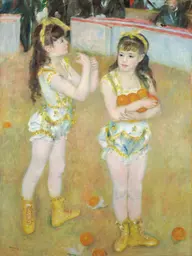
Acrobats at the Cirque Fernando (Francisca and Angelina Wartenberg)
Francisca and Angelina Wartenberg, sisters who performed as acrobats at the Cirque Fernando in Paris, take their bows in the ring. One holds an armful of the oranges that the audience threw as a tribute. Renoir posed them in his studio so that he could paint them by daylight. Oil on canvas, 131.2 × 99.2 cm.
Acrobats at the Cirque Fernando (Francisca and Angelina Wartenberg) source
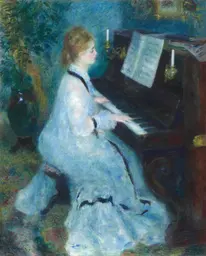
Woman at the Piano
A young woman in a white dress trimmed with a dark ribbon plays an upright piano in a room of deep blues and greens. Renoir paints the dress as a cloud of pale blue, violet and white strokes, the brightest thing in the picture. Oil on canvas, 93 × 74 cm.
Tate, art terms: ImpressionismNational Gallery, London, glossary: ImpressionismNational Gallery, London: Guide to ImpressionismGetty Art & Architecture Thesaurus: Impressionist (style)