Movement
Zhe school
1400–1650 · 1 artist · 2 works
A tradition of professional and court painters in Ming-dynasty China, named after Zhejiang province and known for dramatic landscapes and bold, expressive brushwork. The Zhe school is named after the province of Zhejiang.
MoreLess
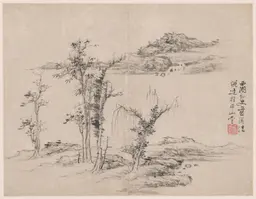
Dai Jin, who lived from 1388 to 1462, is traditionally considered its founder. Its painters were professionals, and some served at the Ming court. They followed the style of the painting academy of the Southern Song dynasty and turned its quiet, poetic scenery into dramatic views on a large scale. Museums describe Zhe school pictures as full of drama, close observation and expressive brushwork: wind and rain breaking over a village, or fishermen at work with their cormorants. The scholar-amateur painters called the literati set themselves apart from such professional work and ranked their own tradition higher. Lan Ying, a professional painter born in Hangzhou, is traditionally considered a last representative of the school. He also moved among the literati and learned the methods of many old masters by imitating them, as his album leaves in the manner of Ni Zan and Gao Kegong show.
Works
2 worksLandscape in the Style of Ancient Masters: after Ni Zan (1301-1374)
A few thin trees on a bank, a stretch of empty water, low hills beyond. Lan Ying painted this leaf in the manner of Ni Zan, a master who had lived three centuries earlier, as one of a set of landscapes after the old painters. Album leaf, ink and colour on paper, 31 × 40.7 cm.
Landscape in the Style of Ancient Masters: after Ni Zan (1301-1374) source
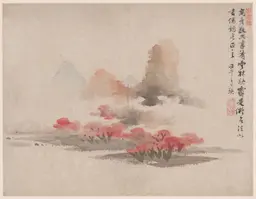
Landscape in the Style of Ancient Masters: after Gao Kegong
Red autumn trees stand in mist below mountains made of soft washes of colour, with hardly an outline anywhere. On this leaf Lan Ying follows Gao Kegong, a painter of cloudy hills who died in 1310, and dates his own work to 1642. Album leaf, ink and colour on paper, 31 × 40.7 cm.
Landscape in the Style of Ancient Masters: after Gao Kegong source