Artist · Zhe school
Lan Ying
1585–c. 1664 · Chinese · 2 works in WOW
Professional painter from Hangzhou, often called the last master of the Zhe school, who also learned to paint in the manner of many old masters. Lan Ying was born in Hangzhou and decided early to become a famous painter.
MoreLess
He was a professional, not a scholar-amateur, and is often called the last important master of the Zhe school, a tradition of professional painters. His dates are uncertain: usually 1585 to about 1664, sometimes 1578 to 1660. Yet he knew the scholars' world well. He was in close contact with literati such as Dong Qichang and Chen Jiru, who shared their views with him and opened their collections of old paintings. From these he learned the methods of many earlier masters, a practice called fang, or imitation, and used them to widen his own range. In one set of landscapes in the style of ancient masters he follows Gao Kegong, Ni Zan, Fang Congyi and Wang Meng, and he also paid homage to Huang Gongwang. His landscapes can show more decorative brushwork and richer colour than the orthodox manner of the scholar-painters. He formed a style of his own and inspired younger painters, among them Chen Hongshou and Liu Du.
Where to see their work
1 place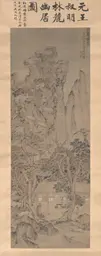
Works
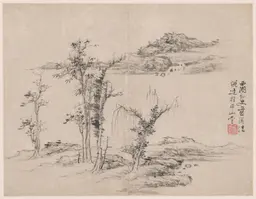
2 worksLandscape in the Style of Ancient Masters: after Ni Zan (1301-1374)
A few thin trees on a bank, a stretch of empty water, low hills beyond. Lan Ying painted this leaf in the manner of Ni Zan, a master who had lived three centuries earlier, as one of a set of landscapes after the old painters. Album leaf, ink and colour on paper, 31 × 40.7 cm.
Landscape in the Style of Ancient Masters: after Ni Zan (1301-1374) source
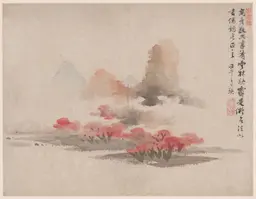
Landscape in the Style of Ancient Masters: after Gao Kegong
Red autumn trees stand in mist below mountains made of soft washes of colour, with hardly an outline anywhere. On this leaf Lan Ying follows Gao Kegong, a painter of cloudy hills who died in 1310, and dates his own work to 1642. Album leaf, ink and colour on paper, 31 × 40.7 cm.
Landscape in the Style of Ancient Masters: after Gao Kegong source
See something wrong on this page? Report a mistakeOpening soon