Artist · Ukiyo-e
Katsushika Hokusai
1760–1849 · Japanese · 3 works in WOW
Japanese artist of Edo whose woodblock prints of Mount Fuji, among them the Great Wave, made landscape a leading subject of Japanese prints. Katsushika Hokusai was born in Edo, the city now called Tokyo, in the district that is today Sumida.
MoreLess
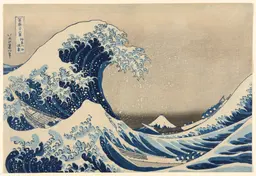
He is said to have drawn from the age of six. At about nineteen he joined the studio of Katsukawa Shunshō and designed prints of kabuki actors. Such prints are called ukiyo-e, which means pictures of the floating world. He was restless. He left that studio in 1794, studied Japanese, Chinese and Western ways of painting, and declared that he would belong to no school. He used more than thirty artist names and is said to have moved house more than ninety times. From 1814 he published the Hokusai Manga, books of sketches that others used as models. His best-known work came in his seventies: Thirty-Six Views of Mount Fuji, made around 1830 to 1833, which includes Under the Wave off Kanagawa, known as the Great Wave. The series made landscape a subject of its own in prints and helped inspire Hiroshige. He died in Edo in 1849, close to ninety. His prints later influenced Vincent van Gogh and Edgar Degas.
Where to see their work
2 places
Works
3 worksUnder the Wave off Kanagawa (Kanagawa oki nami ura), also known as The Great Wave, from the series "Thirty-Six Views of Mount Fuji (Fugaku sanjūrokkei)"
A wave rears over three boats, its crest breaking into claws of foam, with Mount Fuji small and still in the distance. The print comes from Hokusai’s series Thirty-Six Views of Mount Fuji, begun in 1830 when he was seventy, and owes its deep blue to a newly affordable pigment, Berlin blue. Color woodblock print, 25.4 × 37.6 cm.
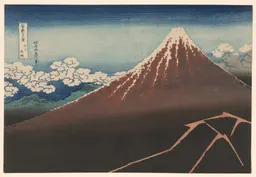
Shower Below the Summit (Sanka hakuu), from the series "Thirty-Six Views of Mount Fuji (Fugaku sanjurokkei)"
Mount Fuji stands in clear air while a thunderstorm breaks far below, its lightning cut into the dark slope like a crack. The print belongs to Hokusai’s Thirty-Six Views of Mount Fuji, a series that in the end ran to forty-six designs. Color woodblock print, 25.7 × 37.6 cm.
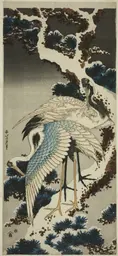
Cranes on snow-covered pine
Two cranes stand on a pine bough heavy with snow, one holding its head high, the other bending to preen. In Japan the crane and the pine both stand for long life. The tall, narrow sheet is a size called nagaban. Color woodblock print, 52.4 × 23.5 cm.
See something wrong on this page? Report a mistakeOpening soon
Art Institute of Chicago: Katsushika HokusaiGetty Union List of Artist Names: Katsushika HokusaiSumida Hokusai Museum: HokusaiSumida Hokusai Museum: The Life of Hokusai