Movement
Ukiyo-e
1615–1868 · 6 artists · 10 works
Japanese pictures of the floating world: paintings and, above all, woodblock prints of actors, beauties and landscapes made for townspeople in the Edo period. Ukiyo-e means pictures of the floating world.
MoreLess
The floating world was the theatre and pleasure districts of Japan's big cities in the Edo period, when the Tokugawa shoguns ruled from Edo, now Tokyo. Kabuki actors and courtesans set the fashions there, and newly rich merchants, low in rank, came to spend their money. A print was the work of four people. The publisher ran the job and sold the prints. The artist drew the design on paper. A carver pasted the drawing face down on cherry wood and cut the block, then one more block for each colour. A printer put colour on the blocks and printed them one after another on handmade paper. Prints were cheap and made in thousands. Full colour arrived in 1765, in Harunobu's time. Its best-known designers run from Harunobu and Kiyonaga through Sharaku's actors and Utamaro to the landscapes of Hokusai and Hiroshige. After Japan opened to trade in the 1850s the prints reached Paris. Their bold outlines, flat colour and cropped views fed Impressionism and Post-Impressionism: Mary Cassatt made colour prints after seeing them in 1890, and Van Gogh copied two Hiroshige prints in oils.
Works
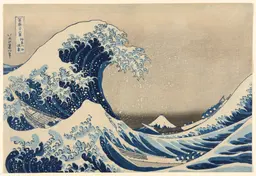
10 worksUnder the Wave off Kanagawa (Kanagawa oki nami ura), also known as The Great Wave, from the series "Thirty-Six Views of Mount Fuji (Fugaku sanjūrokkei)"
A wave rears over three boats, its crest breaking into claws of foam, with Mount Fuji small and still in the distance. The print comes from Hokusai’s series Thirty-Six Views of Mount Fuji, begun in 1830 when he was seventy, and owes its deep blue to a newly affordable pigment, Berlin blue. Color woodblock print, 25.4 × 37.6 cm.
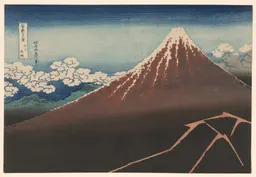
Shower Below the Summit (Sanka hakuu), from the series "Thirty-Six Views of Mount Fuji (Fugaku sanjurokkei)"
Mount Fuji stands in clear air while a thunderstorm breaks far below, its lightning cut into the dark slope like a crack. The print belongs to Hokusai’s Thirty-Six Views of Mount Fuji, a series that in the end ran to forty-six designs. Color woodblock print, 25.7 × 37.6 cm.
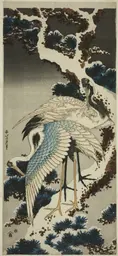
Cranes on snow-covered pine
Two cranes stand on a pine bough heavy with snow, one holding its head high, the other bending to preen. In Japan the crane and the pine both stand for long life. The tall, narrow sheet is a size called nagaban. Color woodblock print, 52.4 × 23.5 cm.
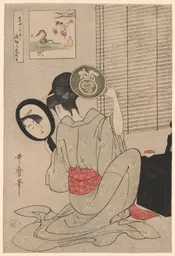
Takashima Ohisa
Ohisa, the daughter of a tea seller near the Ryogoku Bridge and one of the most admired young women in Edo, checks the back of her hair with two mirrors. Utamaro lets us see her face only as a reflection. Colour woodblock print, 38 × 25.8 cm.
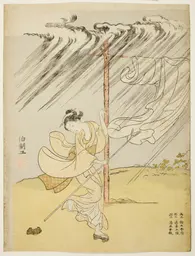
A Young Woman in a Summer Shower
A sudden shower sends a young woman running to save the washing, and she loses a sandal on the way. This sheet was privately commissioned in 1765, the year in which Harunobu’s full-colour printing first appeared in Edo. Colour woodblock print, 28.8 × 21.7 cm.
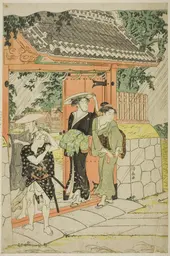
Sudden Shower at Mimeguri Shrine
Caught by a cloudburst, passers-by crowd under the gate of the Mimeguri Shrine, beside the Sumida River. This is the left sheet of a three-sheet design. Kiyonaga’s tall, calm figures set the style for prints of fashionable Edo in the 1780s. Colour woodblock print, 37.9 × 25.1 cm.
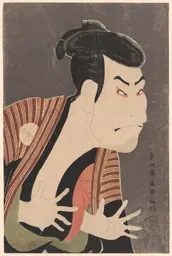
The actor Otani Oniji III as Edobei
The kabuki actor Otani Oniji III plays Edobei, a servant about to commit a robbery, in a play staged in Edo in 1794. Sharaku’s actor portraits appeared over only about ten months, and nothing certain is known of his life. Colour woodblock print, 37.9 × 25 cm.
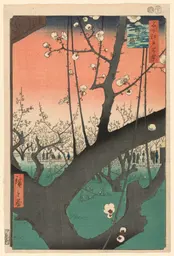
Plum Garden at Kameido (Kameido Umeyashiki), from the series "One Hundred Famous Views of Edo (Meisho Edo hyakkei)"
A dark branch of the most famous plum tree in Edo, known as the Sleeping Dragon, cuts across a red sky while visitors stroll behind a fence in the distance. Vincent van Gogh copied this print in oil paint in 1887. Colour woodblock print, 36 × 24.4 cm.
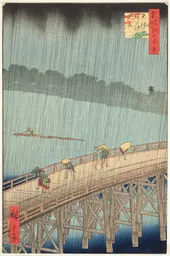
Sudden Shower over Shin Ohashi Bridge and Atake (Ohashi Atake no yudachi), from the series "One Hundred Famous Views of Edo (Meisho Edo hyakkei)"
Six figures hurry across a wooden bridge over the Sumida River as a summer storm breaks, and a lone boatman poles a raft through the rain. The dark cloud at the top was wiped onto the block by hand for each impression. Colour woodblock print, 33.4 × 21.8 cm.
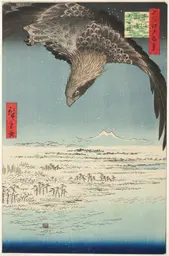
Fukagawa Susaki and Jumantsubo (Fukagawa Susaki Jumantsubo), from the series "One Hundred Famous Views of Edo (Meisho Edo hyakkei)"
An eagle hangs over the snow-covered shore of Edo Bay, its wings spanning the top of the sheet. Nobody in 1857 had seen the city from this height: Hiroshige imagined the view. Colour woodblock print, 33.3 × 22 cm.