Artist · Ukiyo-e
Kitagawa Utamaro
c. 1753–1806 · Japanese · 1 work in WOW
Edo print designer best known for close-up portraits of women and scenes of their daily lives, later much admired by artists in Paris. Little is recorded about Kitagawa Utamaro's life, and even his birth year, about 1753, is approximate.
MoreLess
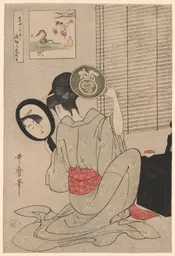
He began to study painting early, in the studio of Toriyama Sekien. Through Sekien he met Tsutaya Jūzaburō, a leading publisher in Edo, now Tokyo, who also published Tōshūsai Sharaku. Utamaro began with illustrations for books of comic verse. The Insect Book of 1788 sets love poems beside finely printed insects and flowers. He then turned to women, and in the 1790s he was at his peak. He introduced portraits that show only the head and upper body, often against a plain ground that shines with powdered mica. He followed the courtesans of the Yoshiwara pleasure district through the hours of the day, and he also drew mothers with children and women cooking or combing their hair. He is said to have been jailed for three days and handcuffed for fifty in 1804. He died in Edo in 1806. Late in the century his prints were in great demand in Paris, where Mary Cassatt was among the artists who admired them.
Where to see their work
1 place
Works
1 workTakashima Ohisa
Ohisa, the daughter of a tea seller near the Ryogoku Bridge and one of the most admired young women in Edo, checks the back of her hair with two mirrors. Utamaro lets us see her face only as a reflection. Colour woodblock print, 38 × 25.8 cm.
See something wrong on this page? Report a mistakeOpening soon