Artist · Ukiyo-e
Suzuki Harunobu
c. 1725–1770 · Japanese · 1 work in WOW
Edo print designer credited with the first full-colour Japanese woodblock prints in 1765, filled with slender young figures and scenes drawn from poetry. Suzuki Harunobu worked in Edo, the city now called Tokyo.
MoreLess
His birth year is uncertain: museums give 1724 or 1725. His early prints used only a few colours, mainly red and green. In 1765 it was the fashion in Edo to swap picture calendars at gatherings, and Harunobu designed many. His patrons were wealthy, well-read townsmen from poetry circles. A separate woodblock was carved for each colour, and marks cut into the blocks kept the paper lined up, so any number of colours could be printed on one sheet. The results were called nishiki-e, or brocade pictures, after the rich woven silks of Kyoto. Full colour soon became the normal way to make a Japanese print. He drew slim, graceful young women and men, children at play, and people of his own day acting out old poems and legends, such as those of the poet Ono no Komachi. His finest prints all date from his last five years. He died in 1770. Torii Kiyonaga later made his own version of Harunobu's series Eight Views of the Parlor.
Where to see their work
1 placeWorks
1 workA Young Woman in a Summer Shower
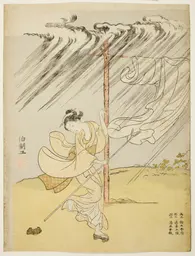
A sudden shower sends a young woman running to save the washing, and she loses a sandal on the way. This sheet was privately commissioned in 1765, the year in which Harunobu’s full-colour printing first appeared in Edo. Colour woodblock print, 28.8 × 21.7 cm.
See something wrong on this page? Report a mistakeOpening soon