Movement
Early Renaissance
1400–1500 · 9 artists · 44 works
The first age of the Renaissance in Italy, roughly the 15th century, when painters in Florence learned to give figures weight and to set them in a space that looks real. Renaissance is a French word for rebirth.
MoreLess
In Italy it meant a wish to equal the art of ancient Greece and Rome, which was seen as the best there had been. Historians usually speak of two periods. The Early Renaissance is the first, and it covers roughly the 15th century. The new, more lifelike style began in Florence with the painter Masaccio and the sculptor Donatello. Figures became weightier and more solid, and the space around them was built more convincingly. Painters began to use linear perspective, a way of drawing in which lines that run into the distance meet at one point. Many large works are frescoes, painted on wet plaster one day's patch at a time. In the Atlas the name is used in this sense, for the period, as the National Gallery in London defines it. The walls of the Sistine Chapel in Rome belong to it by date: the Vatican Museums give 1481 and 1482 for their frescoes. In those two years Perugino, Botticelli, Ghirlandaio and Cosimo Rosselli, with Luca Signorelli, Biagio d'Antonio and other helpers, painted the Stories of Moses and of Christ there, and a series of portraits of the popes. The High Renaissance followed in the early decades of the 16th century.
Works
44 worksLives of St Stephen and St Lawrence
The frescoes that cover the chapel. They begin on the wall to the right of the altar and run round the room in two bands, setting the two deacon saints side by side from their consecration to their martyrdom. The museum calls the decoration one of the great works of fifteenth-century Italy.
The Diaconal Consecration of St Lawrence
One scene of the cycle, in the lower band to the right of the altar. Lawrence kneels before the pope, who sits among his clergy in a blue cope and tiara, to be made a deacon.
The Crossing of the Red Sea
The escape through the Red Sea occupies the third surviving panel of the Moses cycle. The Vatican Museums give this fresco to Biagio d’Antonio.
The Crossing of the Red Sea sourceThe Crossing of the Red Sea source
The Temptations of Christ
The north-wall Christ cycle continues with the temptations, combining related moments within one painted setting.
Scenes from the Life of Moses
Moses appears at different moments in one landscape, including his defense of Jethro’s daughters and the burning bush.
The Punishment of Korah, Dathan and Abiram
The rebellion against Moses and Aaron is represented in multiple episodes within an architectural landscape.
St Sixtus II
St Sixtus II, one of the early popes painted in the chapel in 1481 and 1482, identified by his place in the series: high on the north wall, on the altar side of its sixth window.
St Anacletus
St Anacletus, one of the early popes painted in the chapel in 1481 and 1482: high on the north wall, on the altar side of its first window.
St Alexander I
St Alexander I, one of the early popes painted in the chapel in 1481 and 1482: high on the north wall, on the entrance side of its first window.
St Telesphorus
St Telesphorus, one of the early popes painted in the chapel in 1481 and 1482: high on the north wall, on the altar side of its second window.
St Pius I
St Pius I, one of the early popes painted in the chapel in 1481 and 1482: high on the north wall, on the entrance side of its second window.
St Soter
St Soter, one of the early popes painted in the chapel in 1481 and 1482: high on the north wall, on the altar side of its third window.
St Victor I
St Victor I, one of the early popes painted in the chapel in 1481 and 1482: high on the north wall, on the entrance side of its third window.
St Callistus I
St Callistus I, one of the early popes painted in the chapel in 1481 and 1482: high on the north wall, on the altar side of its fourth window.
St Pontianus
St Pontianus, one of the early popes painted in the chapel in 1481 and 1482: high on the north wall, on the entrance side of its fourth window.
St Fabian
St Fabian, one of the early popes painted in the chapel in 1481 and 1482: high on the north wall, on the altar side of its fifth window.
St Lucius I
St Lucius I, one of the early popes painted in the chapel in 1481 and 1482, identified by his place in the series: high on the north wall, on the entrance side of its fifth window.
St Felix I
St Felix I, one of the early popes painted in the chapel in 1481 and 1482, identified by his place in the series: high on the north wall, on the entrance side of its sixth window.
St Clement I
St Clement I, one of the early popes painted in the chapel in 1481 and 1482, identified by his place in the series: high on the south wall, on the altar side of its first window.
St Evaristus
St Evaristus, one of the early popes painted in the chapel in 1481 and 1482: high on the south wall, on the entrance side of its first window.
St Sixtus I
St Sixtus I, one of the early popes painted in the chapel in 1481 and 1482: high on the south wall, on the altar side of its second window.
St Hyginus
St Hyginus, one of the early popes painted in the chapel in 1481 and 1482: high on the south wall, on the entrance side of its second window.
St Anicetus
St Anicetus, one of the early popes painted in the chapel in 1481 and 1482: high on the south wall, on the altar side of its third window.
St Eleutherius
St Eleutherius, one of the early popes painted in the chapel in 1481 and 1482: high on the south wall, on the entrance side of its third window.
St Zephyrinus
St Zephyrinus, one of the early popes painted in the chapel in 1481 and 1482: high on the south wall, on the altar side of its fourth window.
St Urban I
St Urban I, one of the early popes painted in the chapel in 1481 and 1482: high on the south wall, on the entrance side of its fourth window.
St Anterus
St Anterus, one of the early popes painted in the chapel in 1481 and 1482: high on the south wall, on the altar side of its fifth window.
St Cornelius
St Cornelius, one of the early popes painted in the chapel in 1481 and 1482, identified by his place in the series: high on the south wall, on the entrance side of its fifth window.
St Stephen I
St Stephen I, one of the early popes painted in the chapel in 1481 and 1482, identified by his place in the series: high on the south wall, on the altar side of its sixth window.
St Dionysius
St Dionysius, one of the early popes painted in the chapel in 1481 and 1482, identified by his place in the series: high on the south wall, on the entrance side of its sixth window.
St Caius
St Caius, one of the early popes of the chapel’s series: high on the entrance wall, first from the left as you face it from inside.
St Marcellinus
St Marcellinus, one of the early popes of the chapel’s series: high on the entrance wall, second from the left as you face it from inside.
St Marcellus I
St Marcellus I, one of the early popes of the chapel’s series: high on the entrance wall, third from the left as you face it from inside.
St Eutychian
St Eutychian, one of the early popes of the chapel’s series: high on the entrance wall, fourth from the left as you face it from inside.
The Calling of the Apostles
Peter and Andrew are called in the foreground, with the calling of James and John represented farther away.
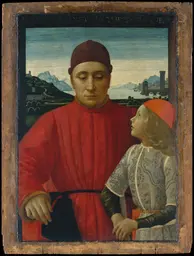
Francesco Sassetti (1421–1490) and His Son Teodoro
Francesco Sassetti, manager of the Medici bank, stands with his young son Teodoro in front of a landscape of hills and water. The father looks down and the boy looks up, and their names run across the top in Latin. Tempera on wood, 84.5 × 63.8 cm.
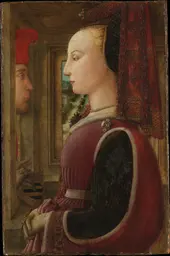
Portrait of a Woman with a Man at a Casement
A woman in profile stands in a small room while a man looks in at the window, his hands resting on a coat of arms. This is the earliest surviving double portrait in Italian painting, and the first to place its sitters indoors. Tempera on wood, 64.1 × 41.9 cm.
The Baptism of Christ
The first surviving north-wall scene depicts Christ’s baptism. The earlier Nativity on the altar wall was removed for the Last Judgment.
Christ Giving the Keys to Saint Peter
Christ gives Peter the keys in the foreground. Related episodes appear within the architectural setting behind them.
Moses’s Journey into Egypt
The journey to Egypt and other related episodes occupy the first surviving panel of the Moses cycle.
The Sermon on the Mount
This panel joins the Sermon on the Mount with the healing of a leper.
The Last Supper
Behind the supper, the painting includes episodes of the Passion in separate background scenes.
Moses Receiving the Tablets of the Law
Moses’s ascent, the golden calf and the renewed tablets are told within the same painting.
The Testament and Death of Moses
The Moses sequence ends with his final instructions and death before entry into the Promised Land.
The Testament and Death of Moses sourceThe Testament and Death of Moses source